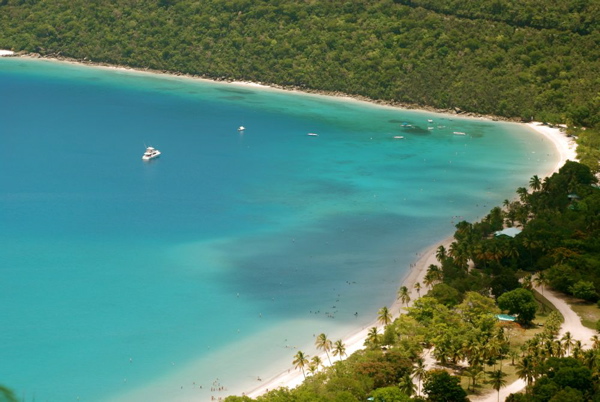
 As the public becomes aware of the plan to create a zipline at Magens Bay, local businessman Michael Ball has outlined his vision for what he is calling the Magens Bay Eco Park.
Ball was disappointed with initial Source reports that did not include his side of the story, which he laid out in detail during a lengthy interview Saturday.
For starters, he explained that the canopy tour differs from a zipline in that it is not purely adventure driven but much slower paced and tied far more into the appreciation of the local environment.
Plans for the eco park include the canopy tour and The Nature Conservancy’s hiking trail. The canopy tour would be built and managed by the Original CanopyTour, creators of Costa Rica’s successful canopy tour that has been featured on the National Geographic Channel and the Discovery Channel.
The entrance for the eco park would be just off the Magens Bay Road on property owned by Ball’s family and would consist of a loop where passengers would be dropped off. According to Ball’s proposal, use of a simple drop-off area will enable taxis to immediately continue to Magens Bay for the return segment of the tour. Because the tour ends at Magens Bay Beach, locals and overnight guests with rental cars would probably need to park down at the beach and take a taxi up to the eco park entrance.
Guests who want to hike will be given trail maps and then proceed to explore the existing Nature Conservancy trail, with trail guides on hand to ensure a safe, enjoyable walk. Aaron Hutchins, The Nature Conservancy’s director of government relations, feels that “the trail itself will be managed better and improved” if incorporated into the eco park.
Canopy riders will continue along a walkway constructed of wood and other natural materials to the staging area. The proposal states that the staging area and all elements will be designed to be minimally invasive and use natural building materials that will be camouflage in color and nature. The cable itself will be green and created out of a composite Kevlar and polymer encased material used by NASA that is said to eliminate noise.
According to Ball, the canopy tour platforms will be very similar to the deck built in the hiking trail by The Nature Conservancy.
“The objective is to leave the least amount of footprint as possible,” said Ball.
Using a patent-pending, dual-line safety system, riders are propelled by gravity during the 600-foot descent. The course traverses a natural water gut for approximately 1.5 miles, with stops at four platforms.
Both riders and hikers would come together again in an area between the beach and the Alphonso Nelthropp Arboretum but Ball made it clear that the landing site could be moved if necessary. He believes that with the landing site adjacent to the arboretum, more visitors would actually explore the arboretum, which is currently not the case.
Ball also said there would be no retail shops anywhere in the eco park.
Ball also explained the fee structure. The cruise lines would charge $100 per person and keep $50 of that. The Magens Bay Authority would get $6 per person, leaving a total of $44 to Ball.
From that $44, Ball will pay approximately $8 to $10 for transportation, $6 to $8 for extensive insurance coverage, $4 to $6 to The Nature Conservancy, an undetermined amount to the management company, and will still have to cover employee payroll, taxes, and maintenance fees.
Ball has promised free educational tours for organized field trips from local schools and said the park will employ local workers in all areas, from the initial building of the park to manning the canopy tour and guiding hikers.
“At the end of the day,” said Ball, “I personally think that there are good things that can be done with this.”
Despite the Magens Bay Authority board’s secrecy regarding the proposed park, as reported in earlier Source articles, Ball presented his proposal in a formal and professional manner at one of its regular public meetings in the light of day. He also said he would welcome public hearings on the matter as he believes this park has many potential benefits.
“Environmental awareness via tourism is a major world-wide trend,” said Ball, “and many countries, including our neighboring islands, have embraced such responsible developments, resulting in … benefits to their respective local economies – cruise lines send more ships and the number of overnight guests has increased.”
Ball said he would much rather build an eco park than develop condos on the many acres owned by his family.
Said Ball, “All I’m trying to do is improve our tourism product.”