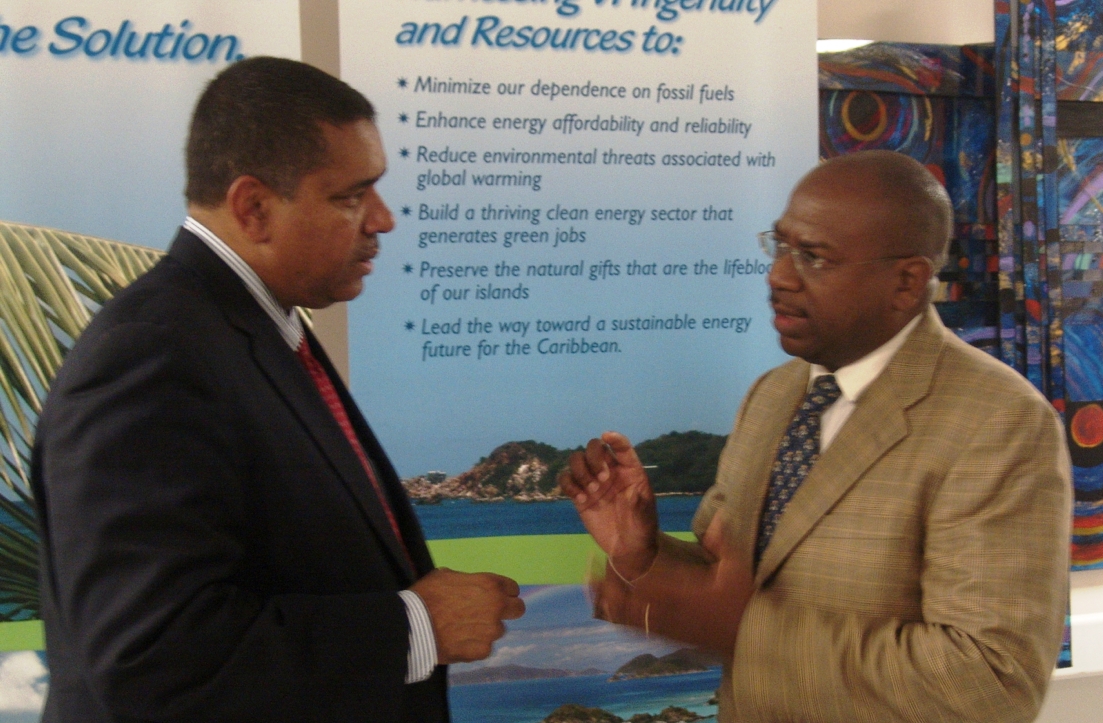
 Natural gas may be part of the solution to providing energy at affordable prices to the U.S. Virgin Islands, Gov. John de Jongh Jr. said Thursday in the keynote address of the of the Renewable Energy and Water Production Conference.
The two-day conference, "Harnessing Sun, Sea and Wind throughout the Caribbean," began Wednesday and was held at the V.I. Cardiac Center at St. Croix’s Juan F. Luis Memorial Hospital.
The conference, presented by Quality Electric Supply Inc., included panel discussions and workshops on such topics as financing and grants, water production and management, renewable energy strategies for residential and commercial properties, the role of generators in renewable energy projects, solar power, wind turbines and waste water management.
Scores of people representing power producers, government agencies and utilities were on hand.
DeJongh spoke about his administration’s efforts to reduce the territory’s dependence on fossil fuels, and of the economic boost such efforts can give the region.
The territory is still on track to achieve his goal of reducing the use of fossil fuels 60 percent by the year 2025, he said. “If we stay committed to the path it is very much achievable.”
The challenge is to do it in the midst of a sluggish economy, but the governor said one of the factors holding down that economy is also one of the big spurs for energy diversification, the closing of the Hovensa oil refinery. Now the territory has to wean itself off petroleum, according to deJongh, and is taking steps to do so.
One of those is exploring a transition from petroleum-fueled generators for the Water and Power Authority and switching to natural gas. It’s a long way from a done deal, and there are plenty of hurdles yet to overcome, but the governor said it’s a distinct possibility.
Natural gas is much less expensive than petroleum and much more abundant. There are also ample supplies of it in North America, which means there aren’t issues about being dependent on foreign oil. Across the United States utilities and refineries and big manufacturing companies are converting, and reaping big benefits, with electricity bills that are fractions of similar bills in the territory.
The conversion of WAPA’s generators from oil to natural gas is a straightforward mechanical engineering process, the governor said. But supply and storage are the big issues.
In the states, it’s just a matter of tapping into existing pipelines or building new ones. Out here in the Caribbean, the fuel has to be shipped in, and the amounts needed for the territory are relatively small and difficult to ship economically. If the fuel is shipped as liquid natural gas, a plant might need to be set up to convert it back to a gas.
One solution might be found 40 to 50 miles to the west, where Puerto Rico is also showing interest in converting to natural gas. With its larger population and industry, Puerto Rico would make it more economical to ship gas to the region, then barge it to the V.I., deJongh said.
And the U.S. Virgin Islands are just the first in a long chain of islands that could benefit from the less expensive fuel, he added, increasing the incentive for a business to set up a supply chain.
The territory is proceeding on a variety of other paths aimed at reducing dependence on petroleum, including recent contracts to install solar electric panels on both St. Thomas and St. Croix, wind turbines and investigation of creating an energy grid.
It seems they’ve already achieved their goal of reducing the dependence on petroleum by 60% with all the power outages. Solar panels and Wind Turbines will turn this Caribbean Gem into costume jewelry. Not to mention that Wind Turbines rarely work as planned in places they’ve been tried. Do the research not the BS search that these companies are SELLING you.
I would take issue with this statement “Wind turbines rarely work as planned in places they’ve been tried” Wind turbines do work. The average wind speed for the VI is 12 mph, more than enough for power generation. I once visited a large wind turbine farm in Central America, and came across an engineer making adjustments on one of the commercial units, and asked him about the cost and economics of the system. He was very animated and negative in his response, saying wind turbines are not cost effective unless the power company charges at least 25 cents a kilowatt-hour “and who does that” he retorted. I could have told him of our rates (highest in the hemisphere) but thought it would sound just too unbelievable. Regarding “Solar panels and Wind Turbines will turn this Caribbean Gem into costume jewelry” ??? I power my home with solar panels and wind (off grid), sorry but I do not think of them as costume jewelry. And isn’t the current “Gem” more like a hunk of coal with an oily wrapping?
“He was very animated and negative in his response,” Because he understood the issue first hand. Power companies here would add the rate onto the prevailing rate. And who would do that? The Legislature-that’s who. Your energy situation is the exception and not the rule. Tourists (assuming we can attract them) come here to see a lush Caribbean Island. Not solar reflectors and wind turbines defacing the vistas. A better idea yet would be to harness all the hot air and gas blowing out of the Legislature. That could surely power the VI for years to come.
The problem is that tourists do not pay for electricity, directly. They do not conserve when on vacation, A/C runs 24/7 with doors and windows open.
WE have to be able to afford electricity which we are barely able to do and the sky high rates we pay affect everything in our lives including the costs of groceries. We need to do something before all the stores that must run lights and A/C can no longer afford to remain in business while we continue to bear the exceesive costs in our everyday lives.
Tourists come for clean beaches, great snorkeling, white sand and blue water.
If we cannot provide a clean, safe, affordable product, they won’t be coming any longer.
I do like the hot air and gas harnessing idea!
You make some good points, it is true that tourist don’t arrive to see wind turbines and solar reflectors (photovoltaic panels) but do they come to see diesel smoke stacks ? A large oil refinery? I think those are a big blights on the Caribbean “Gem”. I also think tourists would appreciate stepping off the cruise ships and walking under 100 year old Mahogany trees, but that won’t happen now. I’ve been privileged to lived in a place that blended environmental conservation and tourism, Costa Rica. A place where tourists spends lots of money to see trees and forests preserved, and one of the most popular tourist spots there, Lake Arenal sports over 100 large wind turbines. I would prefer to see wind turbine on the oil refinery land anytime from what is there now. Don’t fool yourself, there are plenty more Caribbean “Gems” around, some with beaches and scenery as nice as ours, and they are making inroads ecotourism. When it comes to solar panels doting the landscape look down at the VI using Google Earth, see all those rectangular roofs facing up, cover most of those and a good part of our energy needs are meet. And while we are it, make WAPA buy back the extra power we solar home owners produce, and have them stop putting up barriers.