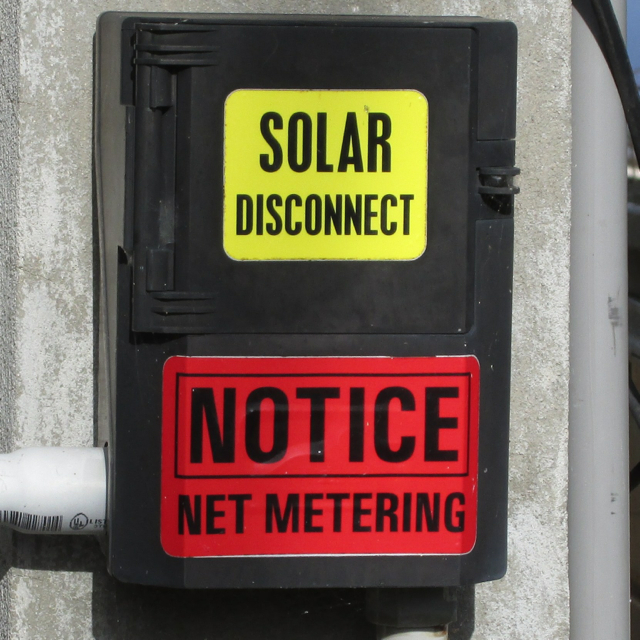
 The Department of Planning and Natural Resources has stopped issuing permits for net metering on St. Croix and in the St. Thomas/St. John/Water Island District, Government House announced Wednesday.
“We just don’t want to go over the limit,” said Bevan Smith Jr., who serves as head of Planning’s building permits division.
St. Croix reached its five-megawatt capacity and St. Thomas, St. John and Water Island are getting close to their 10-megawatt capacity.
Smith said Planning is reconciling its numbers with those of the V.I. Water and Power Authority to get an accurate picture of how many megawatts are being produced on St. Thomas, St. John and Water Island. He said residents of those islands can still submit applications. When Planning determines how much capacity remains, residents will be issued net metering permits in the order in which the applications were received.
Smith said that on St. Croix, 581 residents received permits for net metering. On St. Thomas, St. John and Water Island, the number stands at 737.
"It is clear that net metering has been accepted by our community, however the department has the responsibility to implement the program in accordance with the limitations of legislation,” Planning Commissioner Alicia Barnes said in a press release.
V.I. Energy Office spokesman Don Buchanan agreed that the program is a big success. He said that on St. Croix, about 15 percent of the load capacity comes from solar.
Changes are coming for those net-metering customers who produce large amounts of power. Under the Feed in Tariff program passed by the Legislature in April, WAPA customers who produce more than 10 kilowatts but less than 500 kilowatts will sell their power to WAPA at a rate to be set by the Public Services Commission based on WAPA’s avoided cost.
“WAPA still has the cost of maintaining the full amount of the resource for customers who need it only on a rainy day,” Hodge said, referring to net-metering customers who only need to use WAPA power when their own systems don’t meet their demand.
The change is necessary because net-metering customers whose production equals or is greater than their usage are not paying any share of WAPA’s overhead. When the net-metering law was passed in 2007, WAPA agreed to give net-metering customers a credit on their bill equal to the amount of electricity they produced based on WAPA’s retail rate. WAPA Director Hugo Hodge said that number stands at 51 cents a kilowatt hour, but WAPA’s production cost is somewhere in the mid-20 cents.
According to Smith, residents who already have net-metering systems under 10 kilowatts are set for life and will not have to participate in Feed in Tariff. However, he said those, mostly businesses, with systems that produce more than 10 kilowatts will have to convert to Feed in Tariff when their systems are 10 years old.
Hodge wasn’t quite as confident that current net metering customers won’t face a change. He said he understands there’s a proposal in the works to set 2025 as a sunset date for the net-metering program. He said if the proposal goes through, net-metering customers would then convert to Feed in Tariff.
While the new law will help WAPA, potential net-metering customers still won’t be able to get permits because when the Legislature passed the Feed in Tariff system it did not expand the capacity.
Hodge said grid alternative energy systems like the two now in the works on St. Thomas and St. Croix would work better for the authority because it would serve all Virgin Islands residents, not just those who own homes and were able to hook up to net metering.
It figures, the one piece of legislation in decades that actually gave a privilege to the people of these Islands has been suspended and most of the percentage of net-metering has been stolen by large net producers of solar energy.
The home owner was at least benefiting from the decrease in his or her electric bill. The big solar arrays are benefiting by putting money in their pocket and our auspicious leaders have failed to tell the difference between Power Producers and Power Users.
There are quite a few companies who were counting on the net metering to continue for years as household by household contributed to the percentage allowed.
These companies employed locals and taught a trade to their employees.
A couple of months ago I had an argument with one of the local companies about how I felt the net-metering model, as it stands, is not sustainable. He argued we had at least 5 more years on St. Thomas. He’s now probably sending his 6 employees home and they will be collecting unemployment insurance, rather than paying income tax.
Now companies are allowed to essentially Strip Mine the island to put in these huge arrays and believe it or not, there is no difference between them and a household of 4 when it comes to net metering in the eyes of the Government.
So Senators, give away $Millions in tax money to established Broadband Suppliers, give away the biggest percentage of Net Metering to the big Power Producers who can help with campaign money, enact a no smoking bill that doesn’t take into account the open air of many of the bars,(I don’t smoke), pass an emissions act to test cars who might be putting out extra emissions which are blown away in 5 minutes by the trade-winds and will cost citizens huge sums to get their vehicle in compliance. Continue to look for the essentials and tax more and more of those items necessary for life on these Islands.
That’s what you’re good at, identifying what is needed and slapping a tax on it.
I did notice we gave enormous tax breaks to the Big 3 internet suppliers with no strings and did it unanimously; but my internet bill hasn’t decreased one cent.
I guess when you make as much as a Senator with all the perks, it’s hard to remember what the grassroots are going through.
Very well sated Kenny!!
Thank you.