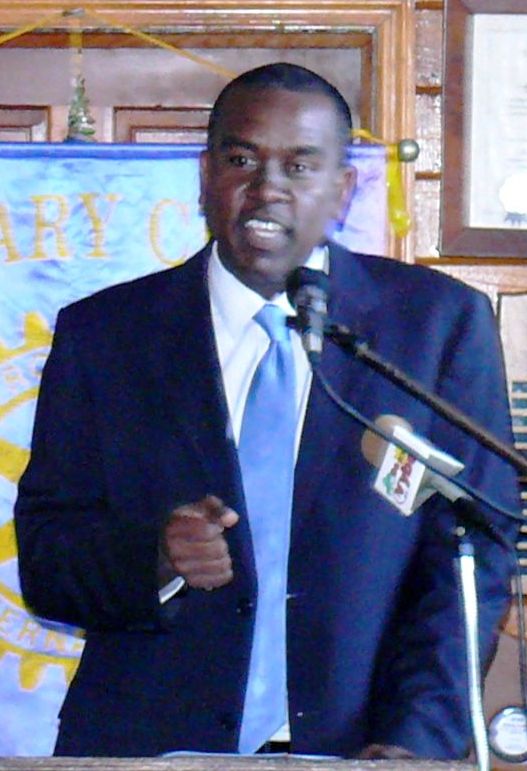
 Hovensa’s closing will hurt employment and business, but if some large capital projects start soon and the territory capitalizes on sports and medical tourism, expanding outside college admissions and technology industries, it will weather the transition, Labor Commissioner Albert Bryan told Rotarians at Gertrude’s on Thursday.
"I think we have to be positive and remember the Virgin Islands may be facing difficulty, but still has an employment rate of 91.5 percent," Bryan joked. "St. Croix still has 90.4 percent working and St. Thomas has 92.3 percent employment," he said.
Although Hovensa recently announced it has completed shutting down the refinery, the loss of several thousand direct and contract employees at Hovensa has not yet flooded the local labor market, Bryan said. The workers still have several months of severance pay and unemployment benefits will not begin until that is exhausted.
Many may find work before their severance ends, so they do not end up using unemployment, Bryan said. But many will not.
Right now, about 1,700 people in the territory are collecting unemployment. Currently the V.I. government is going into debt with the federal government at a rate of $1.5 million to $1.7 million per month. If all the former Hovensa and Hovensa contractor workers hit the rolls right now, the territory would suddenly be borrowing $4 million to $5 million per month, Bryan said.
He said, the territory has to make payments for the first 26 weeks of unemployment insurance, but the next 52 weeks are paid entirely by the federal government, softening the damage.
"I want to be clear there is no need to worry about checks coming out," Bryan said. The federal government will continue to back the payments, but eventually the territory will have to start charging employers a levy to begin paying the federal government, he said. The Legislature repealed an employer levy to cover unemployment insurance some years ago, at a time when the fund was flush, Bryan said. If the levy were reinstated, the territory would still borrow during tight times, but would be able to pay off the debt in better economic times.
Labor is applying for federal grants for training and educational programs for the former Hovensa workers, he said. Ultimately, Labor projects about 40 percent of the former 2,400 or so employees – and their families – will leave St. Croix. Many will probably leave over the summer, before school starts, so families don’t disrupt their children’s school year, Bryan said.
In the medium and long run, the territory should be able to take advantage of its new technology park and access to serious broadband bandwidth at Global Crossing on St. Croix, he said. Noting many local businesses struggle to compete with online stores, and the businesses that do well tend to be for local services that cannot be shipped in, Bryan suggested that should work in the other direction too. "We should be selling our products to the world the same way," he said.
Investments in education will be critical, and the internet provides opportunities for bright, motivated, educated people regardless of location, he said.
"Anybody here ever play ‘Angry Birds’? What if a Virgin Islands youth came up with the next killer app like that?" Bryan said. "It’s a simple app, but 30 million people paid a dollar to download it."
Education itself can be a growth industry too, he suggested. If UVI has programs for them, the territory can attract students from the continental U.S. and all over the world with its warm, sunny Caribbean climate.
"Whole towns run on the concept of having a university setting," Bryan said, suggesting that investment in expanding UVI’s offerings could bring money into the economy. Students aged 18-22 are fiscally valuable temporary residents, often getting much of their cash directly from their parents and spending it immediately on everything from laundry to groceries to night clubs, he said.
In the short run, getting any major construction project off the ground on St. Croix would be very helpful, whether it is a new sports facility in Frederiksted or work on the long-stalled proposed resort at Williams and Punch, he said.
"If we can get one of these started, it will really put a dent in unemployment," he said.
So, St. Croix small businesses are going to see a roughly 17-20% increase in LEAC when WAPA switches to their new oil supplier, increased gross receipts tax, and now a additional tax to pay for unemployment checks, and he thinks they’re going to be hiring?
News flash, most small to medium sized businesses aren’t going to be able to stay afloat, let alone hire anybody amid the increasing costs of energy, taxes and the enormous loss of money spent on-island by former HOVENSA employees.
The hopes of St. Croix are pinned on “medical tourism?!?!” This from a territory whose hospital is frankly 3rd-world in terms of quality of care and procedures offered. Not to mention hospital that is beyond financially bankrupt. And we expect wealthy people from the states to travel here to get their procedures done? Time for a wake-up check Mr. Commissioner, anybody on-island that has the luxury of planning and can afford to flees the island for PR or MIA for any medical care! Nobody is coming here for healthcare!
The grossly under-educated labor force and youth of the island isn’t going to be leveraging the tech parks to create the next great social media app or ‘angry birds’ game. Let’s look at stats from the last Kids Count. 17 percent of teens age 16 to 19 in the Virgin Islands are not in school and not working, more than twice the 8 percent national rate. Juvenile violent crime arrests are more than double the national average. More than 40 percent of V.I. children entering public school Kindergarten had skills below age level in areas crucial to learning. More than half of all public middle and high school students tested below grade level in reading and math. Seventy-three percent of seventh-graders are below proficiency levels in reading and 45 percent are below proficiency levels in math. Sixty-one percent of 11th-graders are below proficiency levels in reading and 52 percent are below proficiency levels in math.Only 65 percent of Virgin Islanders 18 to 24 years old have a high school diploma or higher degree. I don’t think the esteemed Commissioner remotely understands what it takes to create these technological innovations, but I assure you that the folks of St. Croix don’t have anywhere near close to the skill set or education needed to make such a breakthrough. Pinning our hopes on a ‘what if’ isn’t leadership, planning or the way to the future.
The hope that students from the states will come down to UVI to study in out “warm, sunny Caribbean climate?” Hogwash, pure hogwash. Young adults in the continental US are today, more than ever, are staying in-state for their higher education because of the cost savings in tuition and travel, as well as the comfort, support and closeness of home. Not to mention most state universities offer a very wide variety of degrees and have an extremely high quality of educational services offered. UVI can’t compete in terms of cost, housing, transportation and quality of services rendered when compared to in-state universities. Placing the VI’s hopes of rebounding from the HOVENSA disaster on absurdities like this is irresponsible, Mr. Commissioner.
So we’re left with spending $350 million of the tax payers’ money on more basketball courts and baseball diamonds in Fredriksted? Or the hope that resort developers will actually get through our hostile, combative senate, with their seemingly endless litany of red tape and obstructions, and actually break ground on St. Croix? There are plenty of other islands that offer much nicer attractions and have a very resort-friendly governments, why anybody would fight with our senate to build a resort here is beyond me.
By the way, there’s ‘no worry’ about my unemployment check coming? Because I still haven’t received my income tax refund from last year and I was told to ‘not worry about that.’ Color me skeptical.
Yep, I’m still waiting for my tax refund also…….
Well spoken Iriestx. Just like the legislature, the honorable commissioner is in denial of reality. Medical tourism, UVI or a few basketball and baseball fields are not the solution. The legislature has to enable the private sector in creating employment opportunities instead of increasing tax burden, fees and surcharges. Government cannot create sustainable jobs without the private sector providing a tax base. It’s a continuous downward spiral that feeds on itself.
The level of skilled and educated people available to fill any job opportunities, if created by the private sector, is just another sad statistic. Again, there is a total denial of the current state by the elected and appointed officials.
Well put!