The next steps forward to advance an electrical interconnection project between the territories of Puerto Rico and the U.S. Virgin Islands dominated a productive meeting between Puerto Rico’s Secretary of State, Kenneth McClintock, and Gov. John deJongh Jr. Monday on St. Thomas, according to a statement from Government House. 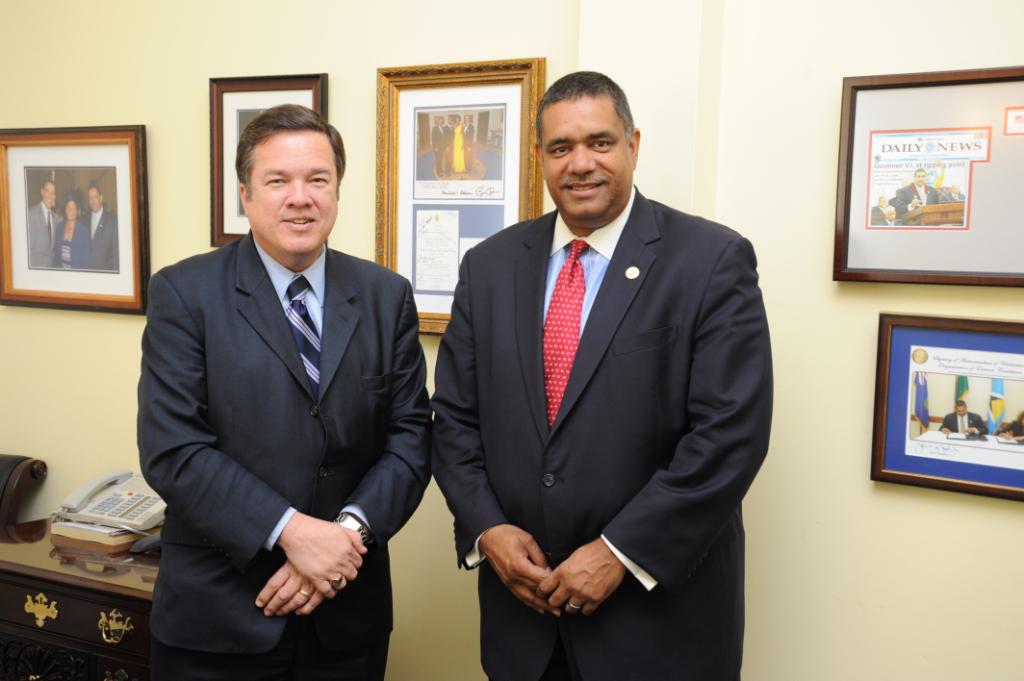
The 50-mile submarine interconnection between Puerto Rico and St. Thomas, as well as other potential phases of the project, has already undergone a technical feasibility study, and officials from both governments are preparing task forces to outline their mutual needs and consider funding sources.
"We had extremely positive talks today, and both governors’ offices are fully committed to connecting our power grids," deJongh said in the statement. "Together, Governor Luis Fortuno and I will reach out to the White House to ask for assistance in identifying additional federal assets to advance our goal of an electrical interconnection between St. Thomas and Puerto Rico,” deJongh said.
Both U.S. territories rely heavily on imported petroleum products and are seeking alternative energy solutions to reduce costs and protect their natural environments. The small, isolated energy markets inhibit efforts to efficiently employ the Caribbean’s abundant wind, solar, and geothermal resources.
By connecting the electrical grids via undersea cables, however, the islands will expand the size of their energy markets and make the development of renewable energy more economically feasible, according to Government House. Puerto Rico could sell its excess capacity to the Virgin Islands, reducing electrical costs for both territories while improving the stability of the grid in the event of a natural disaster.
Energy Secretary Steven Chu and Secretary of State Hillary Rodham Clinton both acknowledged the benefits of the project and the even greater potential of a Caribbean-wide electricity grid in remarks they delivered at the 2010 Energy and Climate Partnership of the Americas (ECPA) Ministerial.
At Monday’s meeting, deJongh and McClintock discussed suitable funding levels and possible sources—private capital, federal grants, or financing. Officials from both territories have also met with federal officials in Washington, D.C. over the last month and a half to discuss possible technical assistance and funding.
“We need this. Puerto Rico wants it. Now we have to work with all our partners to initiate the process that will one day yield this important, game-changing infrastructure,” deJongh said.
The project is currently being studied by the Virgin Islands Water and Power Authority, the Puerto Rico Electrical Power Authority, and both governors’ offices, and officials are in the process of establishing a joint USVI-PR task force, according to Government House. Plans may ultimately include the British Virgin Islands and other Caribbean island nations, deJongh said.
I certainly believe that this is a positive development for the VIs as we struggle with our energy crisis.
AND…It is imperative that we take a serious look at how and why we got to this crisis!
For years now, WAPA has been a VI monopoly that has had little appropriate accountability to the people it is suppose to serve.
There has been political acceptance of the status quo-which quite simply has compounded this problem through the years.
The solution? Open the books! Numbers do not lie.
The people of these Territories have been held hostage- to electrical bills that are astronomical and unrealistic. This is simply wrong.
Certainly alternative energy sources need to be explored AND we also must start to learn from our mistakes…the exact lack of transparency, political appointments to that Board AND a general “closed door” public lack of transparency policies are at the base of too many VI “services”. If we do not start learning from our evident mistakes-we will not move forward as a Territory! Better sunshine laws that are enforced, transparency and openness in Government IS the way to best separate facts from perception! This in turn builds trust…a MUCH needed base of interaction for all citizens with the Government that is supposed to serve them.
Wapa…how about leading the way right now with this much needed change?
Bonny Corbeil, St. John.
Wiil this really help ?
If the VI Government still does not pay its electrical bill we will still have HIGH rates !
The VI Government owes WAPA 14 Million Dollars ! If they were to pay that money WAPA would not have to borrow money to purchase fuel.
Have you walked into a VI Government Office lately ? Its freezing in most offices. The office staff wear jackets and sweaters because its so cold. It must be refreshing to be nice and cool at work while we all sweat it out because we cannot afford A/C in our offices. Though who really cares how cold those Government offices are they DO NOT pay their bills !
The Vigin Islands Government is the largest consumer of electricity in the Virgin Islands. If they were to pay teir electrical bills WAPA rates would drop.
Why keep doing all these studies and fact finding missions ? The answer is simple. PAY YOUR BILL VI GOVERNMENT !
This is just more smoke and mirrors !
DB
Quite frankly, I would rather see the $300 MILLION dollars it is going to cost JUST to connect us with Puerto Rico, to become dependant on their rates, their rate changes and be putting our money into their economy, be spent creating a state of the art electrical generating authority here in the islands to supply ourselves.
PR has its share of outages during hurricane season (and at other times when their power is out for weeks) and if they are down, you better believe that they are going to get Puerto Rico back online before they turn their attention to getting us back online.
It fact PR, tends to get slammed more often than we do during hurricane season.
THIS IS NOT THE ANSWER. THIS IS A COP-OUT!
We need to be self sufficent with our own plant.
$300 MILLION DOLLARS, People!
That should be a sufficent amount of money for providing our own upgraded, cost effective, sustainable utility here in our islands.
Why the heck should we be pumping our hard earned money onto PR’s economy for the rest of our lives and comitting our future generations to the same folly!
Here are how the costs break down in an e-mail from Sue Parten, PE.
” The following is per West Indies Power (Hodge / WAPA wouldn’t release the costs from the Siemens report, but one of the EDIN meetings that discussed that report to know that Siemens numbers were pretty consistent with West Indies Power’s).
$2M per mile for the cable itself. We’re looking at somewhere between 75 and 100 miles, due to need for circuitous routing. So that’s somewhere between $150 and $200M for the cable. They’ve recommended DC cable, rather than AC, because of the fairly long distance run. For the DC cable, you need a $50M inverter on each end of the run. That’s $50M x 2 = another $100M. Total: $250-300 Million.”
We are the ones that shall pay for the BAD decisions with ever increasing costs down the road.
We already pay highly for all the bad decisions our government has made in the past.
Do we really need to continue to pay for all these bad decisions.